As manufacturing processes and products become increasingly software-driven, the skills matrix—a vital tool for managing employee competencies—faces a critical shift. Traditional skills matrices, designed for ISO9001 compliance and suitable for the age of hardware and physical products (Atoms), are no longer fit for purpose in today’s rapidly changing industry where software (Bits) plays a pivotal role. The half-life of skills is shrinking, and the knowledge required is growing exponentially. As we embrace the convergence of Atoms and Bits, manufacturing leaders must rethink how they manage skills and knowledge to remain competitive.
This blog will:
- Delve into why the old methods of skills management no longer suffice
- Introduce a new approach for the age of digital transformation
- Explain how Zipteam’s software can help manufacturing companies build ideal teams that drive innovation and efficiency
The Traditional Skills Matrix: What It Is and Why It Falls Short
The concept of a skills matrix has been widely adopted in large manufacturing companies, particularly for compliance with standards like ISO9001. Traditionally, it involves:
- Defining skills and proficiency levels: Companies specify the key competencies required for various roles and assign employees a proficiency rating. This may be self-reported or assessed by managers.
- Managing skills through self-reporting and manager evaluations: Individual skills are typically rated through a combination of employee self-assessment and managerial feedback. This approach has served well in the past, but it is increasingly inadequate in a rapidly changing digital landscape.
However, the world has changed. With the convergence of Atoms and Bits—the physical and digital realms—this system is no longer sufficient. For example:
- The half-life of skills is shortening: The time a skill remains relevant is decreasing, requiring employees to constantly adapt and learn.
- The volume of skills and knowledge is increasing: The range of competencies needed today is vastly broader than in the past, especially with the rise of advanced technologies like AI, automation, and digital twins.
The traditional skills matrix, designed for a time when manufacturing focused primarily on physical processes, does not scale well in this new reality. Manufacturing companies are increasingly looking for a more dynamic and scalable solution to manage their workforce’s evolving skills and knowledge base.
The New Approach: Separating Knowledge and Skills
In the age of convergence, companies must rethink how they manage knowledge and skills. Here’s why:
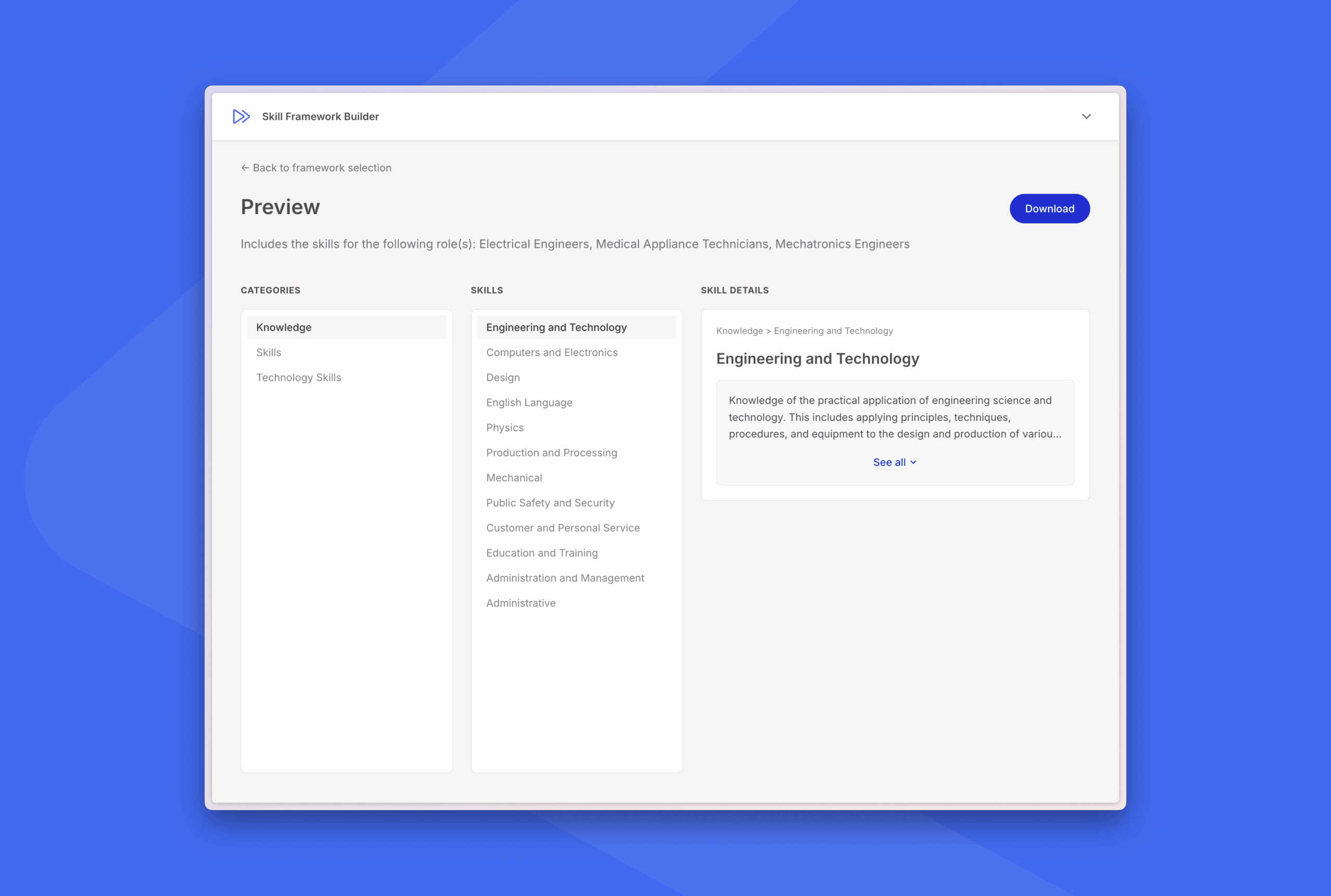
- Knowledge is about who-knows-what within the organization. While not required for the majority of day-to-day tasks, it can be critical for certain projects or when addressing specific challenges. Managing this knowledge, however, is complex.
- Skills, on the other hand, refer to the key competencies required for most of the work done within an organization. These should be defined with proficiency levels, but they must be more adaptable than in the past.
Zipteam recognizes the need to separate knowledge from skills to manage them more effectively. Rather than applying the same framework to both, knowledge should be captured for reference while skills are continuously updated and managed differently.
Borrowing from software engineering, manufacturing companies can adopt the concept of continuous integration (CI) for skills management. In software, CI involves the frequent integration of code to ensure everything works seamlessly. Similarly, companies need a process to continuously integrate new skills into their workforce:
- Track knowledge as it emerges: Knowledge, while not a primary skill, can evolve into a critical competency as project requirements shift.
- Update skills frameworks dynamically: New skills that start as knowledge must be integrated into the skills matrix as the workforce learns and applies them.
This is where Zipteam’s software shines. By providing a platform that dynamically tracks and integrates new skills, it ensures that companies can adapt quickly to new technological developments and project requirements.
Aggregating Skills Data: A Single-Pane-of-Glass Approach
Another critical challenge in the age of convergence is data aggregation. Traditionally, skills have been tracked through various methods such as third-party assessments or internal ratings by managers. However, in a fast-paced, software-defined environment, companies need a single-pane-of-glass view of all skills data.
Zipteam offers a solution by aggregating all skills-related credentials—whether from third-party assessments, manager evaluations, or 360-degree reviews—into one platform. This comprehensive view allows executive decision-makers to gain deeper insights into their workforce, identify skill gaps, and quickly assemble the most qualified teams for any project.
Why Zipteam Is the Best Choice for Advanced Manufacturing Industries
The advanced manufacturing industries are unique, with complex and rapidly evolving demands. Companies in these sectors need a software solution that understands the intricacies of their business. Zipteam is uniquely positioned to offer this level of specialization. Here’s why:
- Industry focus: Unlike most HR Tech vendors, Zipteam is laser-focused on the advanced manufacturing industries. This deep specialization allows Zipteam to tailor its solution specifically to the needs of companies in this space.
- Project team formation: Zipteam focuses on one thing and does it exceptionally well—forming ideal project teams. Other competitors may mix in recruiting, upskilling, and management features, but Zipteam’s singular focus ensures that companies get the right teams for the right projects.
- Deep relationships and understanding: Zipteam has built its software with input from key industry leaders, ensuring that it meets the specific challenges and opportunities of the advanced manufacturing sector.
Zipteam’s Value Proposition: Leveraging Internal Talent Efficiently
By using Zipteam’s software, advanced manufacturing companies can solve key challenges:
- Cost savings on hiring: Companies can better leverage their existing internal talent rather than spending time and money on external hiring.
- Maximized efficiency: Zipteam’s solution helps ensure that projects are staffed with the right skills, improving team performance and project outcomes.
- Data security: In industries where IP and data security are paramount, Zipteam’s platform ensures that sensitive skills data is managed securely.
By leveraging the Zipteam platform, companies can stay ahead of the competition, navigate the complexities of the age of convergence, and ensure their teams are equipped with the skills necessary to succeed.